Insect Pollinators and Their Impact
on Maize Yield in District Swat Khyber Pakhtunkhwa, Pakistan
1Fawad Khan, 2Prof. Dr.
Mahnoor Pervez, 3Dr. Imtiaz
Ali Khan, 4Kamran Khan, 5Sidra Hayat,
5Sumbal Bibi, 5Muhammad
Tayab, 5Noor Shabana.
¹Entomology department Abdul wali khan University mardan Khyber Pakhtunkhwa
Pakistan.
2Zoology Department, Lahore College
for Women University, Lahore,
3Entomology Department, The University
of Agriculture, Peshawar, Pakistan.
4 Zoology Department, University of
Malakand, Pakistan.
5Entomology Department, Abdul Wali Khan
University, Mardan, Pakistan.
Corresponding author: 1Fawad Khan *1medicalentomologist94@gmail.com
|
Received: 30-12-2024 |
Accepted: 06-03-2025 |
First
published online:12-03-2025 |
|
|
Key words: Pollinators, Apis mellifera, maize yield, insect-mediated
pollination, Hymenoptera, Diptera, Coleoptera, crop production, biodiversity,
ecological conservation. |
Abstract The research on the diversity and population
of pollinators and their effect on the yield Pollinators play a critical role
in the agriculture sector, contributing significantly to crop quality and yield,
especially in insect-mediated pollination. Among these, Apis mellifera stands out, accounting for 34-35% of pollination
services globally. This study explores the diversity, population, and impact of
pollinators on the yield of three maize varieties—Azam, Jalal, and Kaptan—in both
caged and uncaged conditions. A total of eight pollinator species belonging to
Hymenoptera, Diptera, and Coleoptera were recorded. Apis mellifera was the most
abundant species, followed by Apis dorsata, Cotinis nitida, and
Xylocopa pubescens. Significant differences were observed between morning
and afternoon pollinator populations, with the latter recording higher numbers.
Yield analysis revealed that uncaged crops significantly outperformed caged crops
across all parameters, including 1000 grain weight, cob length, and number of
grains per cob. The Azam variety exhibited the highest yield among the three varieties
studied. Restricted pollinator activity in caged conditions resulted in reduced
yields, highlighting the essential role of pollinators in maize production. Furthermore,
the use of pesticides and habitat destruction emerged as major threats to pollinator
populations, necessitating conservation efforts such as providing food, shelter,
and diverse floral resources. This study underscores the importance of pollinators
not only for agricultural productivity but also for maintaining ecological balance. |
||
Introduction
Zea maize falls under family Poacea. Maize
comes on the third place among the cereal crops after wheat and rice in Pakistan.
It is a kharif crop which is always planted from mid of July to mid-August and in
general harvested from mid of September to mid of October. As among high yielding
cereal crops, Maize has a great impact on the developing countries, because the
maximum people use it directly as food. Its grain is utilized by some individuals
while in most nations it is utilized in production of corn flour. Sown area is 1
million hectares and its annual production level stands at 1.3 million tons. They
have played a very big role in facilitating the increase in production of this hybrid
varieties. According to US Statistic of Agriculture, in 2019.
Maize is a self-pollinated crop and most of the
pollination is by wind. This plant has both the male and female organ it has flowers
for pollination. The pollens produced in the anther of the tassels dropping on the
hairy ear and pollination is completed. But apart from wind, insects are equally
involved in the pollination of maize crops. The pollinators feed on the tassel as
their food in form of pollen. The pollens cling on these feet and drop it to the
female part when the plant sits on the corn ear. Most crops for fruit, seed and
high market value require insect induced pollination as Klein et al pointed out
in 2007. The pollination contributes toward 35% of the total crops produce in the
world.
About 70% of the fruits and vegetables drawn here
showed that their sizes, quality, quantity, and fruiting stability have gradually
increased through insect mediated and other animals’ pollination. It gives the crops
valued in production in the US a worth of 14.6 billion dollars annually. Research
has established that the native bees are more effective in pollination than honey
bees in watermelons, squashes, tomatoes among others. A worth of 3.1 billion is
the pollinating services performed by native pollinators. Gentleman’s and Vaughan
et al., 2006. A number of globally pollinators are in decline. This has been accompanied
by loss of natural habitats and large-scale production of crops which if it has
an impact on agriculture, will have severe ramification (Potts et al. 2010).
It is important that pollination existing in the
agro ecosystem is preserved for every growing area for crops (Klein et al. 2012).
Large-scale landscape composition at a scale of 1.5km is the dominant factor in
influencing diversity and abundance of the native pollinator (Rikkets et al. 2008).
Previous authors have documented many different ways in which pollinators have been
exposed to pesticides. One of the given proposed reasons for the decline in the
honey bee colonies is that increased Nosema disease impacted the health of the native
bees due to the non-targeted insecticides used for controlling other insects. Because
of the existing paradigm shift whereby colony disappearance and reduction of its
number forced growers and researchers to dedicate significant efforts to studying
bee’s community to keep pollination as a useful form of ecosystem service. Primary
carriers of extinction are identified several times during a year but the individual
exact definition of losses is rather complicated because no all taxa possess the
monitoring of standard population
The Bumble bees and solitary bees was found to
be reduced by 29% by the British wild life before and after 1980 (Bismeijer et al.
2006).
To the hazards of environment; however, a figure
of 54 percent reduction in population of honey bee was witnessed between 1985 and
2005; Similarly, the number and dispersal of lepidopterous pollinators was declined
generally. In their reduction of number, the pollinators have been threatened mainly
by two factors namely; habitat loss and fragmentation. It is argued that associating
wild bees and pollinates with our crops may only be sustained by leaving some of
our lands fallow for the various wild bee species to nest on. Altieri and Nicolos,
2015 also indicated that bee abundance was statistically significantly higher in
natural and semi- natural vegetation than in any arable crop fields surrounded by
monoculture plantations. Some crops require specific attributes from the insect
pollinators or the pollinators that need to be used to pollinate it. For instance,
long-tongued bees performing a function of pollinators for beans. The five beneficial
insect groups such as honeybee, Bumble bees, solitary bees, and hover flies combine
to account for about 35.5% in the oil seed production. The European bees account
for in the region of 80 per cent of the total pollination work done by insects.
The figures have been analyzed that the decrease ratio of honey bees hive across
the world is 70% to 34% in 2007. We have also concluded that the efficiency of bee
VS non-bees’ pollinators; deposition of pollens in one visit to the flowers is low
in other insects as compared to hymenopterans.
1 Pakistan Bureau of Statistics, Agriculture revealed that area
cultivated for Maize crop for the year 2019-2020 is 24349 & 27293.4 hectares
and production of Maize is 1373.9 & 1417.8 tones respectively. In order to investigate
on the kind of insect pollinators, how many of them are there, relation of the insect
pollinators to the maize plants.
Material and methods
Location of Study and Plot Preparation
This research was
conducted at the Agricultural Research Station in Swat during 2021. The maize varieties
Azam, Jalal, and Sultan were sown on three separate plots in July. Each variety
was further divided into four pairs of rows, with each plot measuring 30 x 10 m².
Standard agronomic practices were followed, and no pesticides were sprayed throughout
the experiment to maintain natural pollinator activity.
Experimental Design and Caging
The study was designed using a Randomized Complete Block Design
(RCBD), with a view of controlling for variation in physical factors that include
temperature, aeration and humidities. Because each constructed block consisted of
three replications, nine experimental units were put into use. For the caging study,
nine cages of nylon cloth measuring 8ft in length, 3ft in width and 3 feet in height
were set up. Such cages shielded the tassel from pollinators, and therefore facilitated
main contrast between caged and uncaged maize plants for pollinator activities.
Hand nets, collection jars, killing agents, and insect pins were employed in the
pollinator collection and sample preparations.
Pollinator Options and Sample cooler
diversity
Maize tasseling and flowering function after 15-18th whorl
leaves emerge, causing tassel to become noticeable to pollinators. Vizitation comes
from pollinators was observed early in the morning and also in the afternoon since
activity was more prevalent in the afternoon. Insect pollinators were identified
and photographed, collected using hand nets, subsequently anesthetized through the
application of ethyl acetate, then pinned in collecting vials. The collected specimens
were identified through Ascher and Rasmussen (2010) and M. Valan et al. (2012) insect
identification keys for the study and labeled specimens are stored in Insect Museum
of the Department of Entomology University of Agriculture Peshawar
The number of pollinators was also counted daily for all three
maize varieties in 3 randomly chosen 6 m 2 plots. These observations were carried
from 9A M to 2 PM with one hour each for morning and afternoon session. The pollinating
activity was estimated by counting the number of pollinators starting from the first
inflorescence using a finger counter clicker. Mean values were determined weekly
and multivariate interaction effects of morning and afternoon samples were deemed
significant for pollinator patterns.
How pollinators influence Crop Output
The response of pollinators to maize yield was tested by using
caged and uncaged study designs. Yield parameters associated with this study were
the number of grains per cob, cob length and 1000 grain weight. Overall, all yield
parameters increased in uncaged plots implying that pollinators played a great deal
in determining the productivity of maize grains. The caged plots that were kept
away from pollinating insects self-documented poor yields thus proving that maize
crops rely on pollination by insects.
Statistical analysis and grain yield.
Println
It also emerged that the use of improved seeds responded positively
to the statistical analysis and grain yield as presented below:
Hundred seed weight, number of seeds per cob, as well as cob
length were statistically analyzed for means and comparison using analysis of variance
(ANOVA) method with a software Statistix 8.1. For mean comparisons to determine
population and yield effects of pollinators on the three maize varieties, LSD test
was used. Analysis was done on ten cobs per treatment where 1000-grain weight was
determined using 0.01 digital weighing machine, grains/cob counted by hand and cob
length data analyzed statistically. The outcomes reiterated the fact that pollinator
activity has a direct impact on the yield of maize and therefore has considerable
relevance in the agricultural production matrix.
|
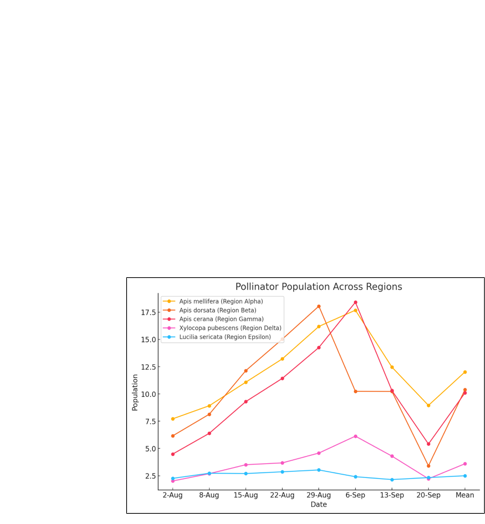
Date |
Apis
mellifera (Region Alpha) |
Apis
dorsata (Region Beta) |
Apis
cerana (Region Gamma) |
Xylocopa
pubescens (Region Delta) |
Lucilia
sericata (Region Epsilon) |
|
2-Aug. |
7.72 |
6.16 |
4.49 |
2.02 |
2.26 |
|
8-Aug. |
8.92 |
8.14 |
6.39 |
2.69 |
2.73 |
|
15-Aug. |
11.08 |
12.14 |
9.3 |
3.51 |
2.7 |
|
22-Aug. |
13.22 |
15.03 |
11.43 |
3.68 |
2.86 |
|
29-Aug. |
16.19 |
18.05 |
14.26 |
4.58 |
3.03 |
|
6-Sep. |
17.68 |
10.24 |
18.41 |
6.13 |
2.41 |
|
13-Sep. |
12.46 |
10.23 |
10.31 |
4.3 |
2.15 |
|
20-Sep. |
8.95 |
3.41 |
5.41 |
2.22 |
2.33 |
|
Mean |
12.02 |
10.4 |
10.1 |
3.6 |
2.5 |
2
|
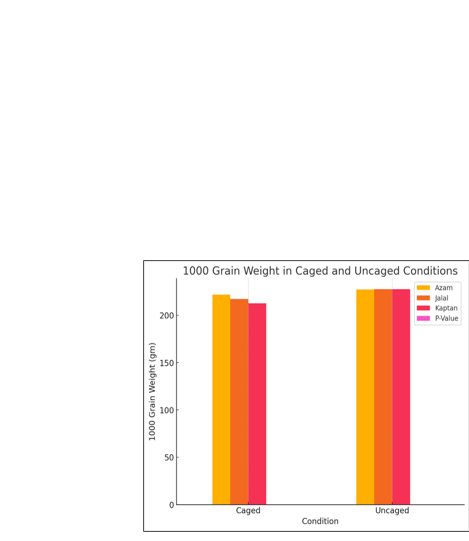
Condition |
Azam |
Jalal |
Kaptan |
P-Value |
|
Caged |
221.92 |
217.38 |
212.48 |
0.01 |
|
Uncaged |
227.45 |
227.54 |
227.56 |
3
|
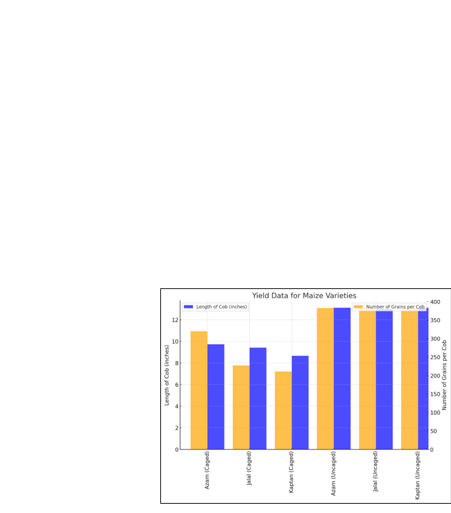
Metric |
Azam (Caged) |
Jalal (Caged) |
Kaptan (Caged) |
Azam (Uncaged) |
Jalal (Uncaged) |
Kaptan (Uncaged) |
P-Value |
|
Length of Cob (inches) |
9.73 |
9.41 |
8.66 |
13.11 |
12.97 |
13.11 |
0.04 |
|
Number of Grains per Cob |
319.84 |
227.13 |
210.71 |
382.33 |
383.4 |
383.13 |
0.02 |
4
Discussion
Impact of Pollinators on Maize Yield and Diversity of Pollinator Species
Pollinators are
vital to agriculture, contributing significantly to crop yields, especially in insect-mediated
pollination. The global agricultural value of pollinators is approximately $153
billion, with Apis mellifera alone accounting
for 34-35% of pollination services (Stein, 2017). Combined natural and insect-mediated
pollination enhances both yield and grain maturity uniformity, as also reported
by Shakeel et al. (2010).
Pollinator Diversity
This study recorded
eight species of pollinators across three maize varieties (Azam, Jalal, and Kaptan).
These species spanned three orders: Hymenoptera
(Apis mellifera, Apis cerana, Apis dorsata, and Xylocopa
pubiscen), Diptera (Eristalis
tenax and Leucilia sericata), and Coleoptera
(Cotinis nitida and Coccinellid sp.). Morning and afternoon observations
showed significant differences in pollinator populations, with the afternoon yielding
higher numbers. The findings align with those of Hung (2018), who emphasized Apis
mellifera as a central figure in pollination networks, and Bartomeus (2014), who
noted honeybees contribute 90-95% of pollination in vegetable crops.
Hymenoptera
Apis mellifera was the most abundant
pollinator, followed by Apis dorsata and Xylocopa spp. Bumblebees
also exhibited higher visitation rates and effectiveness, especially in adverse
conditions, due to their pilosity (Faegri and Valido, 2005).
Coleoptera
Beetles such as
Cotinis nitida and Coccinella septempunctata were active pollinators,
with Cotinis nitida being more prevalent. Their hairy bodies and specialized
mandibles enable efficient pollen transfer, as described by Knees (2020).
Diptera
Syrphid flies were
more abundant and effective than blowflies. These flies visited 70% of crops and
75% of wildflowers, contributing to ecosystem functions like pest control and organic
matter recycling (Doyle, 2020).
Yield Analysis
The yield of uncaged
maize plots was significantly higher than caged plots. Azam variety produced the
highest yield (654.4 kg), followed by Jalal (432.5 kg) and Kaptan (386.6 kg). The
restricted activity of pollinators and limited wind flow in caged plots resulted
in lower yields. These findings corroborate Sneep (2006), who highlighted the synergy
of natural and insect-mediated pollination, and Laberge (2006), who estimated a
60% yield increase due to insect activity. Parker (2006) similarly reported 25%
higher yields in uncaged crops.
Conclusion
Pollinators are
indispensable for enhancing crop yield, fruit set, and uniform seed maturation.
Their conservation is crucial, as habitat loss, pesticide use, and human activities
threaten their populations. Providing shelter, food, and diverse vegetation can
boost pollinator diversity and ensure sustainable agricultural production. Among
the varieties studied, Azam is recommended for pollination-mediated areas due to
its superior yield. Loss of pollinators poses a significant risk to food security
and ecosystem balance, necessitating immediate conservation efforts.
Recommendation
Conservation of
pollinators through habitat restoration and reduced pesticide use is essential for
improving agricultural yields and maintaining ecosystem services. Pollinators not
only enhance crop productivity but also ensure better food quality and sustainability.
References
Abrol, and D.P. 2007. Foraging behavior
of Apis mellifera and Apis cerana as determined by energetic of nectar production
in different Cultivars Branicu campestris bartoria. J. Apic .Sci. 51(2):
19-23.
Ahmad, S,. B, S. A. Dar. and B. A.
Pandith. 2017. Comparative foraging behavior of honeybees, Apis cerana F.
and Apis mellifera L. (Hym: Apidae) on apple bloom. J. Ento. Zoo. Stu. 5(1):
474-482
Aizen, M.A., L.A. Garibaldi, S. A.
Cunningham and A.M Klien. 2008. Long- term global trends in crop yield and production
reveal no current pollination shortage but increasing pollinator’s dependency. Curr.
Biol. 18(20): 1572- 1575.
Altieri, M., and C.I. Nicolls. 2015.
Preservation of wild bees with cropping pattern. J. Agri. Food. Human. Val. Soxc.16:
131-140
Artz, B., Derek.R and B.A.Nault. 2011.
Apis mellifera and native bee in pumpkin. J. Econ. Entom. 104(4): 1153-1161.
Ascher, J.S., C. Rasmusson. and A.
Mehmood. .2010. Identification keys for Bee
fauna of pollinators in Pakistan. J. Res.Gat /271213968
Bartomeus, I., S.G. Potts. and K.M.
Krewenka .2014. Insect pollinators to crop yield. J. NCBI. PMC. 2. e328.
Bhattarcharya, M., and S.K. Chakarborty.
2014. Weather parameters and population of honey bees in forest ecosystem india.
J. Environ. Sci. 37(9): 889-894
Biesmeijer, J.C., S.P. M Robert, M.
Reemer , R. Ohlemuller, M. Edwards, T. Peeters, A.P Schaffers, S.G Potts, R. Kleukers, C.D Thomas, J. Settele
and W.E, Kunin. 2006. Parallel declines in pollinators and insect-pollinated plants in Britain and the Netherlands. Science.
313(5785): 351-354.
Bodlah, I., M. Amjad, M. A. Bodlah
and A. Quyyum. 2013. First record of two genera of Anthophorini and one genus
of Melectini (Apinae: Apidae: Hymenoptera) from Pothwar
Punjab , Pakistan. J. Entomol. Zoo. Stu. 4(4): 1031-1035.
Breeze, T.D., and A.B. Baily. 2011.
Pollination services in UK. J. Agri. Eco. Ent. 142: 137-143
Brittain, C.A., M. Vighi, R. Bommarco,
J. Settele and S.G Potts. 2010. Impact of a pesticide on pollinator species richness
at different spatial scales. J. Basic & Appl. Ecol. 11(2): 106-115.
Bureau of Statistics planning and development
(2012-2020). Government of Khyber Pakhtunkhwa.
Carlio, J.R., F.A. Eischen. And P.D.
Rios. 2007. Pollinators in cantaloup. J. Acta. Zool. Mex. 23(1): 165-159.
Cervonica, C.R., and E.A. Bergonia.
1991. Insect pollinatiors in cucumber. J. Intern. Soc. Hort. Sci. 288: 278-282.
Cronin, J. Thidon and J.D Reeve 2015.
Natural and semi natural habitats and pollinators Proc. Res. Soc. B. 272: 2225-2235.
Doyle, T., L.S. Hawkes. R. Massy. and
K.R. Wotton. 2020. Pollination by hoverflies in Anthropocene. J. Bio. Sci. 287 (1927):
16-21
FAOSTAT, 2020. Data available at http://faostat.fao.org/
default.aspx.
Garantonakis, N., K. Varikou, A. Birouraki,
M. Edwards, V. Kalliakaki, and F. Andrinopoulos. 2016. Comparing the pollination
services of honey bees and wild bees in a watermelon field. J. Scientia Horticulturae,
204: 138–144.
Garratt, M.P.D,. J. Bishop. S. Potts.
A. Shi. And S. Roy. 2018. Insects pollination as agronomic input. J. App. Ecol.
55:2834-2842
Ghazoul, J., and H. Buzziness. 2005.
Questioning the global pollination crises. Trends Ecol. Environ. 20: 367-373.
Haunsted, L., B.W.W. Grout. And J. Eilenberg. 2015. Honey bees and wild pollinators
on Cherry. J. Acta. Agri. Scand.
65(2): 109-117
Hung, K.L.J., A. Mathias. And K.R.
Joshua. 2018. Worldwide importance of honeybees as pollinators. J. R. Ent. Soc.
285
Istiraj, K,. and S. Ahmad. 2010. Pollinators
in cucumber. . Sar. J. Agri. 2(7): 219-222.
Jauker, F., B. Bondarenko. and H. Beker.
2012. Pollination services in oilseed rape. J. Royal. Ent. Sci. 14: 81-87
Khalifa, A.M.S., E.H. Elshafiey. A.E.
Shietaia. A.F. Algethami. And S.H.D. Masry. 2021. Overview of bee pollination and
its economic value for crop production. J. MPDI/Insects.12(8): 688-690.
Khan, M., and J. Rehman. 2004. The
role of honey bees, Apis mellifera (Hymenoptera: Apidae) in pollination
of apple. Pak. J. Biol. Sci. 7(3): 359-362.
Klein, A., B. Vaissiere, H.C.I. James,
S.A. Cunningham, C. Kremen and T. Tscharntke. 2009. Importance of pollinators in
changing landscapes for world crops proceeding. J. Biological Sciences. 274: 303-313.
Klein, A., B. Vaissiere, J. Cane, l.
Steffan-Dewenter, S. Cunningham, C. Kremen and T. Tscharntk. 2007. Importance of
pollination in changing Landscapes for world crops. Proc. Royal Soc. London B. 274(1608):
303-313.
Knap, J.L., and J.L. Osborne. 2019.
Cucurbits as model system for crop pollination . J. Pol. Ecol. 25: 89-102.
Knees, A., C.R. Hooks. And. A. Espindola.
2020. Beetles and pollination. Marry. Land. Agr. News.
Krupke, C.H., and J.D. Holland. 2013.
Exposure of pollinators to pesticides. J. Brit. Ent. Soc. 2: 1449-1458.
Loosey, J.L., and M. Vughan. 2006. Ecological, economic values and
conservation 0f Environmental Policy. J. Bio. Sci. 4: 311-323.
Lorena, A., and M. Quesada and A. Casas.
2009. Importance of insect pollinators. J. Entom. Sci. Agri. 142(5): 1050-1057.
Meena, N. K., B. Singh,
K. Kant, R. D. Meena, and R. K. Solanki. 2015. Role of insect pollinators in pollination
of seed spices-A review. Inter. J. Seed Spices. 5(1): 1-17.
MINFAL, 2008. Agriculture Statistics
of Pakistan. Ministry of food, Agric, and Livestock. Food Agric. Div. (Econ. Wing) Islamabad. pp. 59.60.
Naeem, S., and S. Ahmed. M. Adil. 2015.
Role of pollinators on yield of pea. J. Ento. Zoo. Studies. 6(2): 1280-1282.
Nicoemol, D., R.H.N. Cout. And DD.
Joung. 2009. Role of pollinators in pollination. J. Entom. Agri. Sci. 66(4): 35-42.
Nicola, G., M.S Jean, S. Josef and
E.V Bernard. 2009 Economic valuation of the vulnerability of world agriculture confronted
with pollinators decline. Ecol. Econ. 68(3): 810-821.
Ockinger, E., and H.G. Smith. 2007.
Natural and semi-natural sources for pollinators. J. App. Eco. 1: 50-59
Pettis, J.S., and D.V. Engeldorp. 2012.
Exposure of pollinators to pesticides increases level of nosima. J. PMC. NCBI. 99:153-158
Poots, S.G., J.C. Bismejer. And C.
Kremen. 2010.Global pollinator decline. J.
Ecol. Evo. Sci. 25: 345-353
Rader, R., and I. Bartomeus. 2016.
Importance of non-bee pollinators. J. Proc. Nalt. Acad. Sci. USA. 113: 146-151
Ricketts, T.H., J. Regetz, I. Steffan-
Dewenter, S.A. Cunningham, C. Kremen, A. Bogdanski, B. Gemmill-Herren , S.S Greenleaf,
A.M Klein, M.M. Mayfield, A.M. Lora, A. Ochieng and F.V Bland. 2008. Landscape effects
on crop pollination services: are there general pattern? Ecol. Lett. 11: 499-515.
Sarwar, J., and A. Muhammad. 2008.
Pollinators in cucumber. J. Pak. Ento. 30(2): 185-192.
Shah, I., M. Shah. And A. Usman. 2015.
Response of insect pollinators to different cucumber. J. Ento. Zoo. Stud. 3(5):
374-378.
Shaheen, F.A and M. Hussain. 2017. Role of honey be in production. J. Pak.
Jour. Agri. 30(1): 1-6
Shakeel, M., H. Ali. And S.Ahmad. 2019. Pollinator services in two canola
varieties. Saud. Journ. Bio. Sci. 7:1704-1709
Slaa, E.J., C.L.A Sanchez, K.S. Malagodi-Braga
and F.E Hofsted. 2006. Stingless bees in
applied pollination. Practice and perspective. Apidologie 37: 293-315.
Stein, Katharina., D. Coulibly. And
E.K. Linsenmair. 2017. Bee pollination enhances quality and quantity of crops. J.
Sci. Rep. 17691(7)
Subhakar, G., K. Sreedevi and K. Manjula.
2011. Insect pollinators of bitter gourd. Pest. Man. Horti. 17(1): 23-27.
Thapa, R.B. 2006. Honey bees and other pollinators in cultivated
crops. J. Agri. Ani. Sci. 27(1): 69-74.
USSOA, 2019. Agriculture data on USSTAT.
http//ussoa.org.us
Valan, M., K. Makonyi. A. Maki. D.
Vondrasek. And F.Ronquist. 2019 Automated taxonomic identification of insects with
expert level accuracy. J. Syst. Bio. 68(4): 876-895.
Vidal, M.D.G., D.D. Jong. And H.C.
Wine. 2010. Pollinators and fruitset in cucumber. Brazilian J. Bot. 33(1): 1-45.
Zoua, Y. Xiao., H. Bianchi. And F..J.A.Moringa.
2017. Wild pollinators and rapseeds. BMC. Ecol. 17: 60-66.